
How to Calculate Unweighted GPA: The Simple 4.0 Method
Indeed, your GPA is one of the most important numbers in your academic life. However, the term “unweighted GPA” sounds more complicated than it really is. In this guide, you will learn exactly how to calculate unweighted GPA using the simple 4.0 method, with no advanced math required.
In short, by the end of this article, you will know how letter grades convert to grade points and how to average them across your courses. You will also see how unweighted GPA differs from weighted GPA, work through real examples, and find answers to the most common questions students ask.
What Is Unweighted GPA?
An unweighted GPA is your grade point average calculated on a standard 4.0 scale. As a result, no extra points are given for honors, Advanced Placement (AP), or International Baccalaureate (IB) courses: every A is worth 4.0 points, every B is worth 3.0 points, and so on, regardless of how difficult the class was.
Because it treats every course equally, unweighted GPA is the fairest way to compare academic performance across different schools and course loads. High school students can track their own average with our high school GPA calculator. It is also the version of GPA most commonly reported on college applications.
The Unweighted GPA Scale
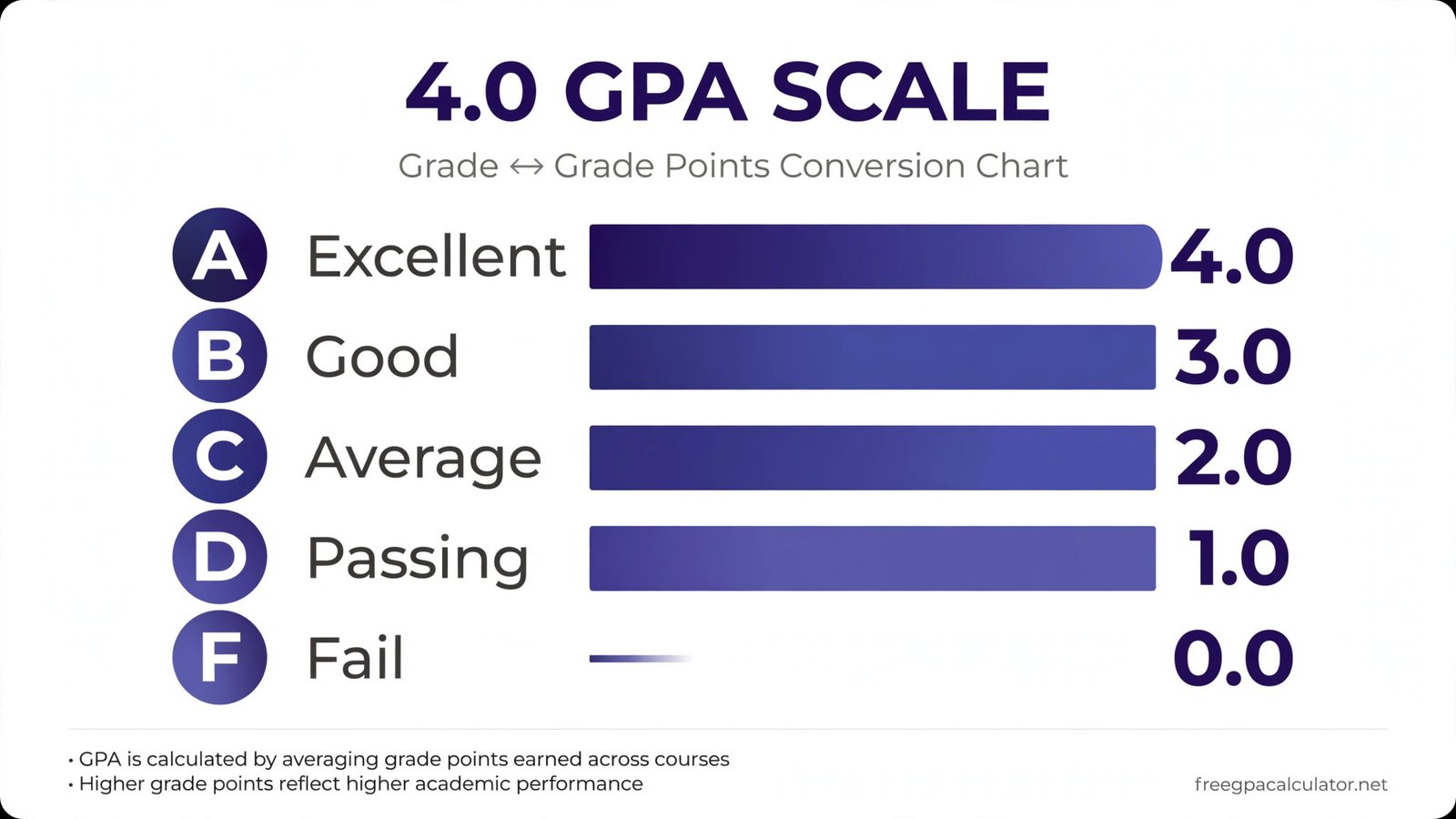
First, look at the foundation of the 4.0 method: the unweighted GPA scale. In other words, each letter grade corresponds to a fixed number of grade points:
| Letter Grade | Percentage Range | Grade Points |
|---|---|---|
| A | 93–100 | 4.0 |
| A− | 90–92 | 3.7 |
| B+ | 87–89 | 3.3 |
| B | 83–86 | 3.0 |
| B− | 80–82 | 2.7 |
| C+ | 77–79 | 2.3 |
| C | 73–76 | 2.0 |
| C− | 70–72 | 1.7 |
| D+ | 67–69 | 1.3 |
| D | 63–66 | 1.0 |
| F | Below 63 | 0.0 |
However, some schools use a simplified version of this scale that includes only whole letter grades (A = 4.0, B = 3.0, C = 2.0, D = 1.0, F = 0.0) without plus and minus distinctions. Therefore, check which version your school uses and follow it for the most accurate result.
How to Calculate Unweighted GPA in 4 Steps
In fact, calculating your unweighted GPA takes just four simple steps:
Step 1: List Your Courses and Final Grades
First, write down every course you completed in the semester or school year, along with the final letter grade you earned in each one.
Step 2: Convert Each Grade to Grade Points
Next, use the scale above to turn each letter grade into its grade point value. For example, an A becomes 4.0 and a B+ becomes 3.3.
Step 3: Add Up All the Grade Points
Then, add the grade point values together to get your total grade points.
Step 4: Divide by the Number of Courses
Finally, divide the total grade points by the number of courses. As a result, this final number is your unweighted GPA.
Worked Example
For example, let us calculate the unweighted GPA for a student who took five courses:
| Course | Grade | Grade Points |
|---|---|---|
| English | A | 4.0 |
| Algebra II | B+ | 3.3 |
| Biology | A− | 3.7 |
| World History | B | 3.0 |
| Art | A | 4.0 |
First, add them up: 4.0 + 3.3 + 3.7 + 3.0 + 4.0 = 18.0 total grade points. Next, divide by 5 courses: 18.0 ÷ 5 = 3.6. Therefore, this student’s unweighted GPA is 3.6.
Unweighted vs Weighted GPA
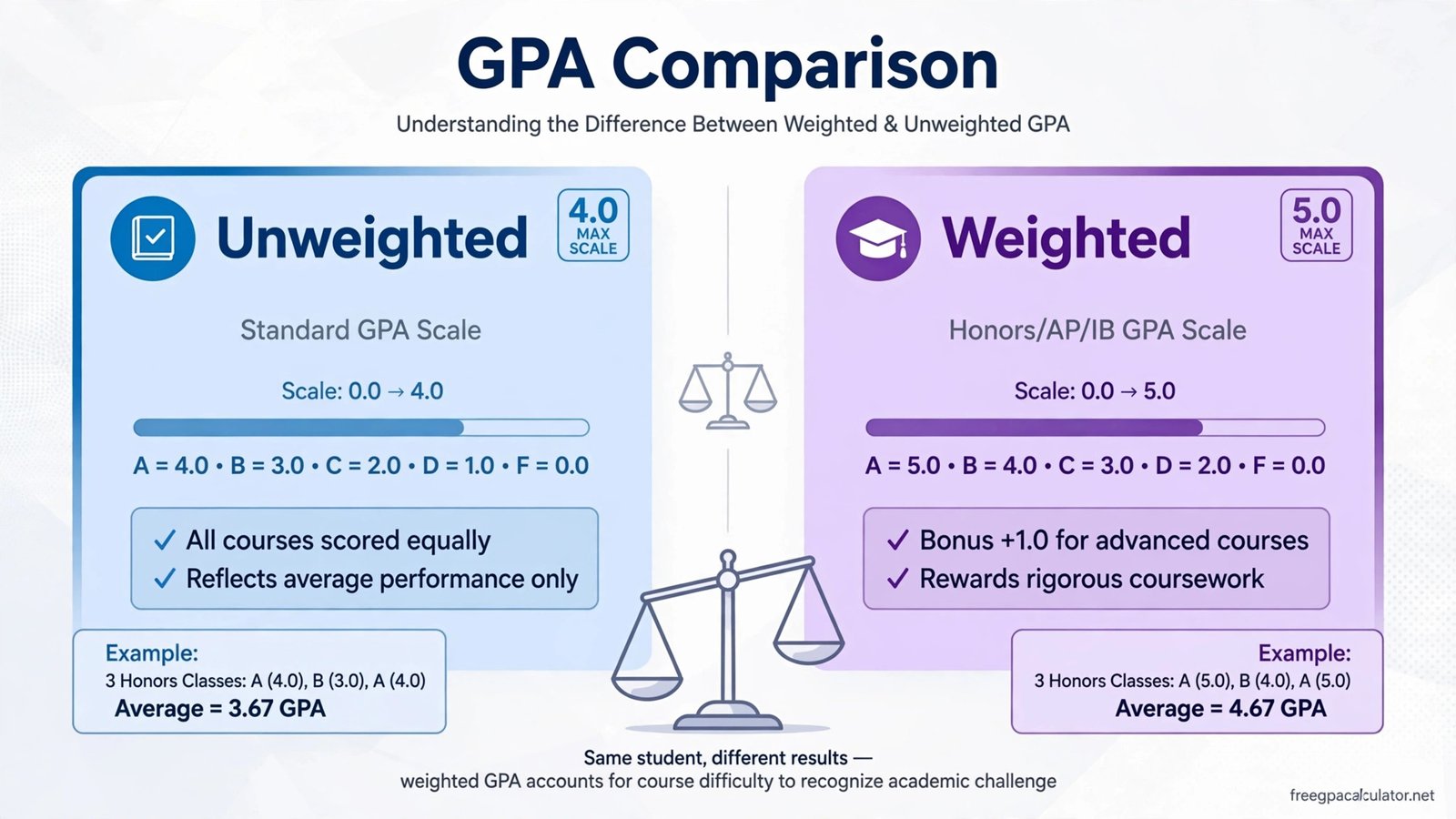
Above all, the main difference between unweighted and weighted GPA is how they treat challenging courses. Specifically, unweighted GPA caps every course at 4.0, while weighted GPA adds bonus points, often up to 5.0, for honors, AP, and IB classes. To see how bonus points change the result, try our weighted GPA calculator.
| Feature | Unweighted GPA | Weighted GPA |
|---|---|---|
| Scale | 4.0 | Often 5.0 |
| Honors and AP bonus | No | Yes |
| Best use | Comparing students across schools | Rewarding course rigor |
| Used by colleges | Widely | Varies by college |
Consequently, many colleges recalculate applicants’ GPAs on an unweighted 4.0 scale so they can compare students fairly, regardless of how each high school weights advanced courses. In addition, Wikipedia’s article on grading in education explains how different grading scales work around the world.
Tips for Raising Your Unweighted GPA
Because every course counts equally in an unweighted GPA, consistency matters more than taking the hardest possible schedule. For this reason, focus on earning strong grades in every class, stay on top of assignments to avoid missing easy points, and ask teachers for help early when a subject gets difficult. For instance, even turning a few B grades into A grades can lift your GPA noticeably over a semester. If you are tracking a cumulative average across multiple semesters, our CGPA calculator can help.
Frequently Asked Questions
What is an unweighted GPA?
An unweighted GPA is a grade point average measured on a standard 4.0 scale, where an A equals 4.0, a B equals 3.0, a C equals 2.0, a D equals 1.0, and an F equals 0.0. It does not add bonus points for honors or AP courses.
How do you calculate unweighted GPA?
Convert each final letter grade to its grade point value on the 4.0 scale, add all the grade points together, and divide by the number of courses. For example, grades of A, B+, and A- convert to 4.0, 3.3, and 3.7, and their average is 3.67.
What is a good unweighted GPA?
Of course, what counts as a good unweighted GPA depends on your goals. Generally, a 3.5 or higher is considered strong, a 3.0 is solid, and anything above 3.7 is excellent and competitive for selective colleges.
Is a 3.5 unweighted GPA good?
Yes. A 3.5 unweighted GPA means your average grade falls between a B+ and an A-, which meets or exceeds the admission standards of many colleges and universities.
More Questions About Unweighted GPA
Do colleges look at weighted or unweighted GPA?
Many colleges look at both. Still, a large number recalculate every applicant’s GPA on an unweighted 4.0 scale to make fair comparisons. They also review your transcript separately to see how challenging your courses were.
Can unweighted GPA be higher than 4.0?
No. By definition, unweighted GPA is capped at 4.0 because no bonus points are added for difficult courses. Only weighted GPA can exceed 4.0.
How do I convert weighted GPA to unweighted GPA?
For this purpose, remove the bonus points your school adds for honors, AP, or IB courses — usually 0.5 or 1.0 extra per advanced class — so every A counts as 4.0. Then recalculate the average on the standard 4.0 scale.
Final Thoughts
In conclusion, calculating your unweighted GPA is simple once you know the 4.0 scale: convert each grade to points, add them up, and divide by the number of courses. Finally, keep track of your GPA each semester with our free GPA calculator so you always know where you stand, and where a little extra effort can make the biggest difference.