

In the digital world, website performance plays a crucial role in user experience, search engine rankings, and overall online success. Whether you run a personal blog, a business website, or an e-commerce platform, page speed and page size are two factors that directly affect how visitors interact with your site.
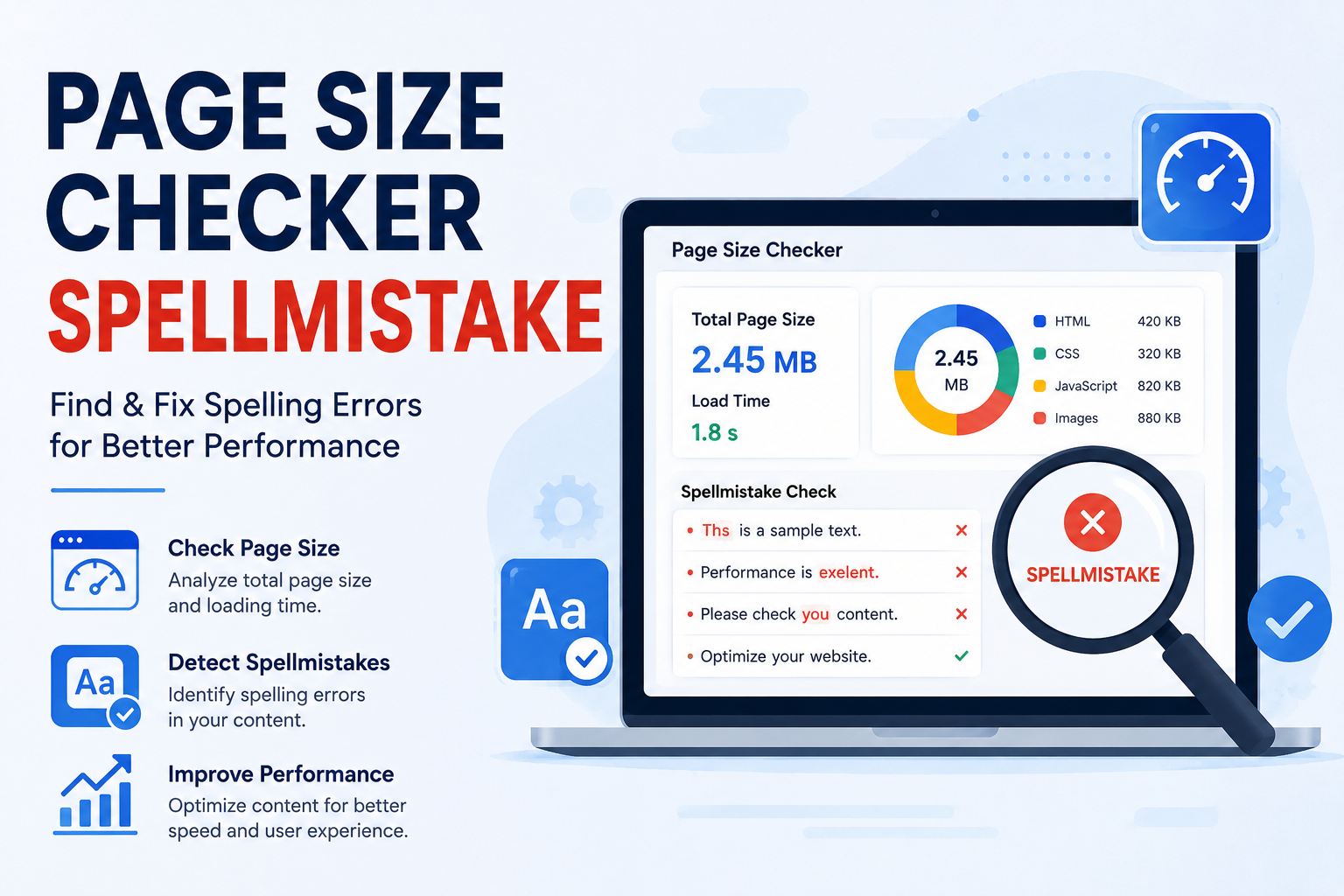
Many website owners use page size checking tools to monitor the amount of data loaded when a webpage opens. During this process, some users come across the term page size checker spellmistake and become confused about its meaning. Is it an error? Is it a tool issue? Or does it refer to spelling problems within page size reports?
Understanding this topic requires looking at how page size checkers work, why spelling errors appear in website audits, and how these issues can impact website performance and SEO. This guide explores the subject in depth while helping website owners avoid common mistakes that affect their online presence.
What Is a Page Size Checker?
A page size checker is a tool designed to measure the total size of a webpage. It calculates how much data must be downloaded when a visitor accesses a page.
The size includes various elements such as HTML files, CSS stylesheets, JavaScript files, images, videos, fonts, and third-party scripts. Larger pages generally take longer to load, especially for users with slower internet connections.
Website owners use page size checkers to identify performance bottlenecks and optimize loading times. These tools provide valuable insights into how much content is being delivered and whether improvements are needed.
When users search for page size checker spellmistake, they are often trying to understand unexpected messages or unusual reports generated by website auditing tools.
Why Page Size Matters for Websites
Page size directly affects website speed.
A webpage containing large images, heavy scripts, or excessive media files requires more data to load. As page size increases, loading times often become slower.
Visitors today expect websites to load quickly. Studies consistently show that users abandon pages that take too long to appear. Slow websites can lead to lower engagement, reduced conversions, and higher bounce rates.
Search engines also consider page performance when evaluating websites. Faster pages generally provide a better user experience and may contribute positively to search visibility.
This connection between performance and optimization is one reason why discussions about page size checker spellmistake have become more common among webmasters and content creators.
Understanding Spellmistakes in Website Analysis
The term spellmistake typically refers to spelling errors found within content, metadata, URLs, reports, or tool-generated outputs.
Sometimes users encounter spelling-related notifications while using website auditing software. In these situations, the page size checker itself may not be malfunctioning. Instead, the tool could be identifying textual errors that exist within the webpage being analyzed.
In other cases, a typo may appear in the tool interface, report title, or generated recommendation.
The phrase page size checker spellmistake often emerges when users notice spelling irregularities associated with performance reports and seek clarification about their meaning.
How Website Auditing Tools Detect Errors
Modern auditing tools analyze much more than page size.
Many platforms evaluate website performance, accessibility, SEO, security, and content quality simultaneously. As a result, reports frequently contain recommendations covering multiple aspects of website optimization.
For example, a performance report might identify large image files while also detecting misspelled words in title tags or headings.
This combination of performance and content analysis can sometimes create confusion. Users expecting only page size information may be surprised to see spelling-related recommendations.
Understanding the broader capabilities of these tools helps explain why searches for page size checker spellmistake continue to appear across online forums and support discussions.
Common Causes of Spelling Errors in Reports
There are several reasons spelling-related issues may appear during website analysis.
One common cause is human error. Website content is often created manually, and even experienced writers occasionally make mistakes.
Another possibility involves automated content generation. When content is produced quickly or imported from external sources, spelling inaccuracies may go unnoticed.
Software localization can also contribute to spelling inconsistencies. Some tools support multiple languages and regional variations, which may cause words to appear differently depending on settings.
Additionally, technical terminology can sometimes trigger false alerts if dictionaries used by auditing tools do not recognize specialized words.
These scenarios frequently contribute to discussions surrounding page size checker spellmistake and similar search queries.
The Relationship Between Spelling and SEO
Spelling errors can affect search engine optimization in several ways.
While occasional typos may not significantly impact rankings, frequent mistakes can reduce credibility and negatively influence user trust.
Visitors often associate spelling quality with professionalism. A website containing numerous errors may appear less reliable, leading users to leave without engaging further.
Search engines prioritize content that provides value and a positive user experience. Clear, accurate writing contributes to that experience.
For this reason, spelling checks are often included alongside performance analysis tools. The overlap between these functions helps explain why the phrase page size checker spellmistake appears in discussions about website optimization.
Why Website Owners Should Care About Page Size
Page size optimization remains one of the most effective ways to improve website performance.
Large pages consume more bandwidth and increase loading times. This can create challenges for mobile users and visitors with limited internet speeds.
Optimizing page size often involves compressing images, reducing unnecessary code, minimizing scripts, and eliminating unused resources.
Regular monitoring helps ensure that performance remains consistent as websites grow.
When combined with content quality checks, these optimization efforts contribute to a stronger user experience and better overall website health.
Identifying Real Errors Versus False Positives
Not every reported spelling issue represents an actual mistake.
Technical terms, brand names, industry jargon, and custom product names may be flagged incorrectly by automated systems.
Website owners should carefully review reports before making changes. Blindly accepting every recommendation can sometimes introduce new errors rather than fixing existing ones.
When investigating a page size checker spellmistake notification, it is important to determine whether the issue involves genuine spelling errors or simply a misunderstanding caused by automated detection.
Manual review remains one of the most reliable methods for verifying reported problems.
Improving Website Content Quality
High-quality content remains essential for online success.
Content should be accurate, readable, informative, and free from unnecessary mistakes. Consistency in spelling, grammar, and formatting contributes to professionalism and trustworthiness.
Regular proofreading can significantly reduce errors. Many website owners combine manual editing with automated tools to achieve the best results.
Keeping content updated is equally important. Outdated information can damage credibility even if spelling and grammar are perfect.
A balanced approach to content quality and technical optimization helps create a website that performs well for both users and search engines.
Best Practices for Managing Page Size
Managing page size effectively requires ongoing attention.
Images should be optimized before uploading. Large files often represent the biggest contributors to excessive page weight.
Scripts and stylesheets should be reviewed regularly to remove unnecessary code. Combining files and enabling compression can further improve efficiency.
Caching techniques can help reduce loading times by storing frequently accessed resources locally.
Website owners should also monitor third-party integrations, as external scripts can significantly increase page size.
These practices complement content quality efforts and contribute to overall website performance.
The Role of User Experience
User experience is at the center of modern website optimization.
Visitors expect pages to load quickly, display correctly, and provide valuable information without errors.
A website that combines fast performance with accurate content is more likely to retain visitors and encourage engagement.
This is why technical audits often evaluate both performance metrics and content quality indicators. The goal is not merely to create a fast website but to deliver a satisfying experience.
Concerns related to page size checker spellmistake often arise because website owners recognize the importance of maintaining both technical and editorial standards.
Avoiding Common Optimization Mistakes
Many website owners focus exclusively on speed while neglecting content quality.
Others prioritize content creation but ignore technical performance issues. Both approaches create imbalances that can limit a website’s effectiveness.
Successful optimization requires attention to multiple factors simultaneously.
Regular audits, performance monitoring, content reviews, and usability testing all contribute to long-term success.
By addressing technical and editorial concerns together, website owners can create stronger, more competitive websites.
The Future of Website Analysis Tools
Website analysis tools continue evolving rapidly.
Artificial intelligence and machine learning technologies are making audits more comprehensive and accurate. Future tools will likely provide deeper insights into both technical performance and content quality.
Automation will help identify issues more quickly while reducing manual effort. However, human judgment will remain essential for interpreting recommendations and making informed decisions.
As these tools become more sophisticated, users may encounter increasingly detailed reports that combine performance metrics with language analysis.
This evolution will likely continue generating interest in topics such as page size checker spellmistake as website owners seek to understand and address various optimization challenges.
Conclusion
The phrase page size checker spellmistake may initially seem confusing, but it generally relates to the intersection of website performance analysis and spelling or content-quality evaluations. Modern auditing tools often assess multiple aspects of a website simultaneously, which can lead to spelling-related alerts appearing alongside page size reports.
Understanding how page size checkers work, why spelling errors are detected, and how these factors influence user experience can help website owners make better optimization decisions. Fast-loading pages, accurate content, and strong usability all contribute to a successful online presence.
Rather than viewing technical performance and content quality as separate concerns, website owners should approach them as complementary parts of a comprehensive optimization strategy. By doing so, they can improve search visibility, enhance credibility, and create a better experience for every visitor who arrives on their website.